
Understanding McIntosh County Releases
A McIntosh County release is an event tied to a specific custodian. At the county level, the McIntosh County Sheriff's Office records when its jail gives up custody and why. A court docket may show the legal order behind that event. Oklahoma VINE may report a custody change. The Oklahoma Department of Corrections, or ODOC, records a different event when someone leaves state prison or shifts to community supervision. No one source answers every release question.
The reason matters most. Bond or recognizance may return a person to the community while the case continues. Time served means enough custody time was credited for release, not that the case vanished. Parole is conditional release from prison before the sentence ends. Probation is court-ordered supervision and may begin without a prison term. Discharge usually marks the end of the correctional duty shown by that record. A transfer only means one custodian handed the person to another.
- Time served
- Custody credit that satisfies the jail or sentence term ordered in that case.
- Detainer
- A request or hold from another authority that may block community release.
- Parole
- Conditional community release while part of a prison sentence remains in force.
- Discharge
- The recorded end of the correctional obligation in the system that issued it.
McIntosh County Release Paths
A person can leave McIntosh County Jail through several lawful routes. Each path sends the search somewhere different. The jail entry should identify whether the person went into the community or into the hands of another agency. Charges shown at booking remain allegations unless a court later enters a conviction, dismissal, or other final result.
| Departure type | Meaning | Next place to verify |
|---|---|---|
| Bond or recognizance | Community release while the case remains pending | Sheriff release event and ODCR docket |
| Dismissal or court order | A judge or filed action authorizes release | Court order plus completed jail event |
| Time served or sentence complete | The applicable county custody term ends | Jail entry, judgment, and liberation instrument |
| Parole or supervision | Community placement continues under conditions | ODOC status and assigned supervision office |
| Transfer or detainer pickup | Custody moves to another authority | Receiving jail, ODOC, BOP, tribal, or federal record |
Can a release time mean freedom? Not always. A timestamp proves departure from that facility only when the disposition also says the person returned to the community. A receiving agency or transfer code means custody continued.
Note: Ask for both the release reason and destination whenever McIntosh County Jail confirms that someone has left.
McIntosh County Release Record Fields
The county has no verified public web screen that defines its release fields. A focused request should seek the existing booking and release entry, not ask staff to create a new report. Identity, facility, time, and disposition form the core. The arresting agency, charges, bond authority, case number, holds, and photograph connect that event to the right person and case.
- Identity
- Full name, aliases, date of birth if maintained, and booking identifier reduce same-name mistakes.
- Booking information
- Booking date and time, arresting agency, charges, and related case number identify the custody episode.
- Release timestamp
- The date and time jail staff completed the recorded movement or release.
- Authority or reason
- Bond, court order, time served, dismissal, transfer, or another maintained disposition explains why custody changed.
- Destination and holds
- A receiving agency or active hold distinguishes community release from continued custody elsewhere.
- Booking photograph
- The image tied to that county booking, if retained and public, is separate from an ODOC photograph.
Retention cannot be reduced to a fixed online window. McIntosh County does not publish a verified release archive or a schedule saying how long a released booking stays searchable. The Oklahoma Open Records Act does not set one jail-record retention term for every item. Ask whether an archived jail register, booking sheet, release log, liberation instrument, or photograph exists.
Request McIntosh County Release Records
Address a narrow request to the McIntosh County Sheriff's Office at 1425 Industrial Drive, Eufaula, OK 74432. The official office line is 918-689-4357, and posted hours are Monday through Friday from 8:00 a.m. to 4:00 p.m. Dispatch can be reached after hours at 918-689-2526. No county online request form, fixed copy fee, or fixed response period was verified. Call first to confirm the present custodian and accepted delivery method.
- Identify the person with a full legal name, birth date if known, booking range, and case or booking number when available.
- Request the existing booking and release entry, release timestamp, release authority, disposition, destination, holds, and liberation instrument.
- Ask for an electronic copy and a fee estimate before work exceeds a limit you choose. Oklahoma law calls for prompt, reasonable access, not one universal number of days.
- If part is withheld, ask for the public remainder and the legal basis for each redaction or denial.
- Compare the response with the related court order. If it says transfer, continue with the receiving agency.
McIntosh County Sheriff's Office
1425 Industrial Drive
Eufaula, OK 74432
918-689-4357
Monday-Friday, 8:00 a.m.-4:00 p.m.
After-hours dispatch: 918-689-2526
The official McIntosh County sheriff page confirms the jail contact and office hours. Its successful source capture shows the local route a requester should authenticate:
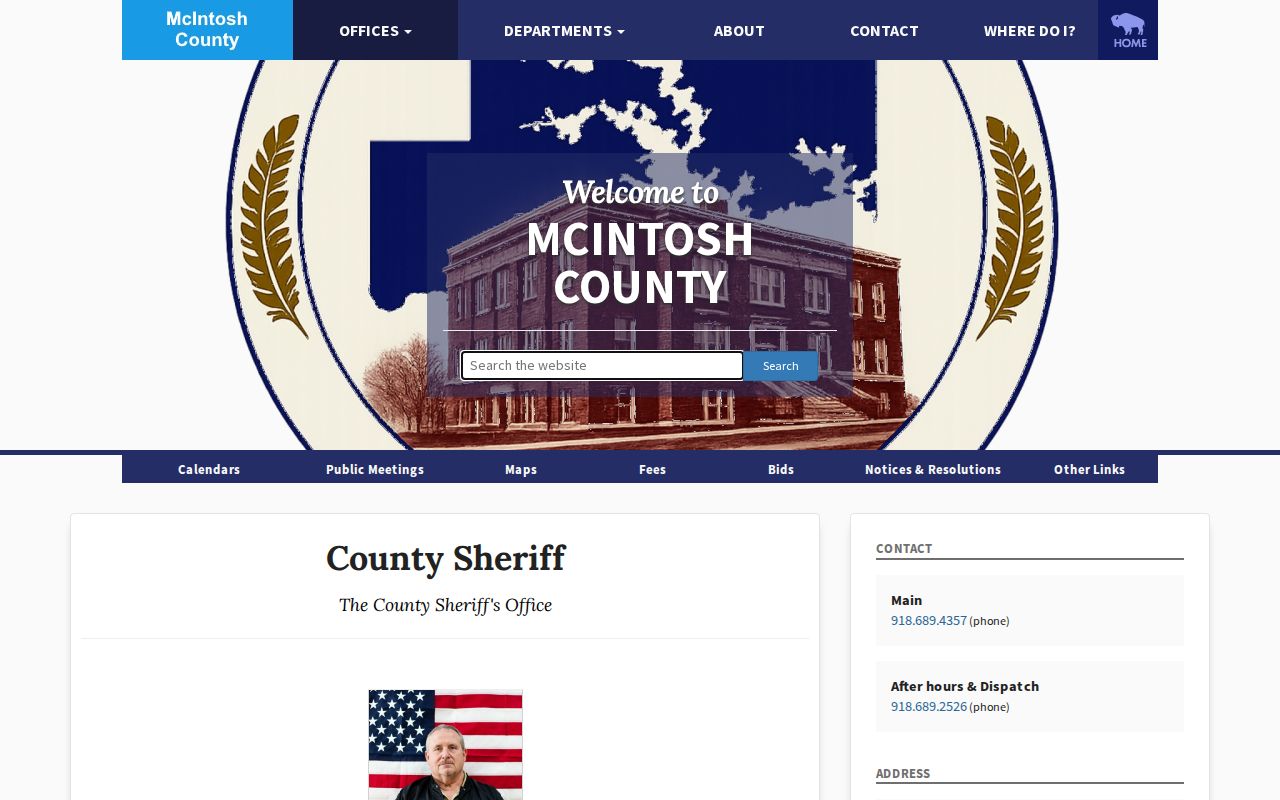
The county office, not a similarly named out-of-state site, is the proper source for an Oklahoma McIntosh release entry.
McIntosh County Release Laws
The Oklahoma Open Records Act, 51 O.S. sections 24A.1 through 24A.32, supplies the main access framework. Section 24A.5 addresses prompt and reasonable access and permissible fees. Section 24A.8 addresses law-enforcement records and public facts concerning an arrest and its disposition. The law does not require every record to appear online, and exemptions, lawful redactions, juvenile rules, and sealing orders still apply.
Record duty: 57 O.S. section 62 requires instruments committing or liberating a jail prisoner, or attested copies, to be endorsed, filed, and safely kept by the sheriff. Access still depends on current law and any valid restriction.
County sentence credit is not the same as pretrial release. Under 57 O.S. section 65, a person serving county-jail time after conviction may receive five days of credit for each four days served when jail rules are obeyed. Section 58.3 concerns qualifying prisoner labor credits. Only the sheriff and court record can show how a rule affected a named person's actual release.
Note: A public docket can explain legal authority, while the jail record confirms when staff carried out the release or transfer.
Expunged McIntosh County Release Records
An Oklahoma record does not seal itself merely because a person may qualify. Sections 18 and 19 of Title 22 govern eligibility and the petition, notice, hearing, and order process. Categories and waiting rules can change. A court order controls what becomes restricted, and different custodians may need to act on a valid order.
After expungement, a public ODCR search may return no result or limited information. That absence does not prove there was never an arrest, booking, or release. It may show that access is now restricted. Do not rebuild sealed facts from old copies. Current statutory text or Oklahoma Legal Aid expungement information is the sound route for legal guidance.
McIntosh Court Records After Release
McIntosh County's own government site routes its Court Records link to ODCR, and McIntosh appears in the county selector. That makes the docket a durable local trail after a name drops from jail data. Search a full name or case number, choose McIntosh County, and read entries after the arrest for bond changes, dismissals, pleas, judgments, sentences, time-served credit, warrants, revocations, and later termination orders.
The ODCR McIntosh County case search can show why a judge authorized release, but it cannot prove the exact jail-door time or clear an unrelated hold. The manifest capture shows the locally endorsed search screen:
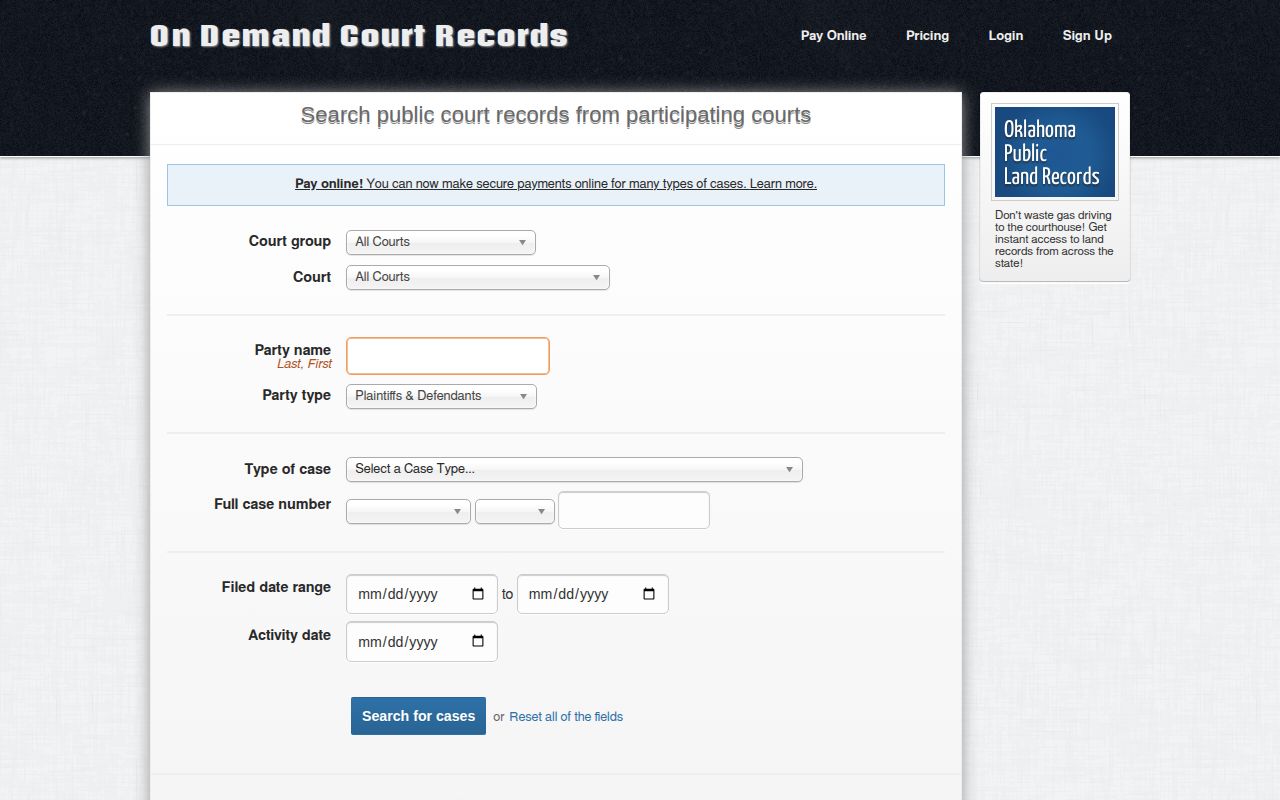
Pair the court entry with the sheriff release event. For authoritative text, request a certified order from the McIntosh County Court Clerk rather than relying on a short docket summary.
Find McIntosh County Released Inmates
Begin with the last confirmed custodian. A McIntosh County Jail booking calls for the sheriff record and county court case. An ODOC prison or supervision history calls for the state offender lookup. A federal sentence calls for the BOP locator. Immigration custody uses ICE tools. These systems may show successive events, but they are not substitutes for one another.
- Confirm identity with the full name, birth date, aliases, and any booking, case, ODOC, or federal number.
- Search ODCR with the McIntosh County filter and note the case number, bond or release order, sentence, and any later hold or warrant.
- Call the jail and ask whether departure meant community release or transfer. Request the date, reason, destination, and existing release entry.
- Check Oklahoma VINE for a reported custody event. Treat release and transfer as different outcomes.
- If the jail names ODOC, BOP, ICE, another county, or another sovereign, move to that receiving system.
- If every search is blank, recheck spelling and custody level, then file a narrow record request instead of declaring the person released.
Roster limit: A released person normally leaves current jail data, but a missing name can also reflect transfer, timing, spelling, or an identifier mismatch. Only a positive release event or receiving-custody record resolves the question.
The local facility record supplies the full departure paths and the sheriff's records contact.
McIntosh ODOC Release Search
The official ODOC Offender Lookup is the main state search when a McIntosh case led to Oklahoma prison custody. It does not document an ordinary county bond release. Accept the service notice, search the known name or ODOC number, match the birth date and identifier, then open the detail. Read status, location or supervision, sentence, court, and date fields together.
| Search or result field | How to use it | Limit |
|---|---|---|
| Name | Start with first and last name, then check aliases | Same-name results require more matching |
| ODOC number | Use the unique state identifier when known | It covers ODOC history, not every county booking |
| Birth date and descriptors | Compare before selecting a detail record | Abbreviated data may not settle identity alone |
| Status or location | Distinguish prison, parole, supervision, and ended custody | Community supervision is not full discharge |
| Sentence and historical dates | Connect the record to the right case and custody period | A future date is tentative and may not be public |
ODOC warns that its public data are abbreviated and may not fully explain the offense, sentence, or time to be served. A parole status means the person has left prison but remains under conditional control. A released or discharged history can support the end of an ODOC custody episode. If a record names a prison or says incarcerated, the person is still in state custody.
Does every ODOC profile show an exact future date? No. ODOC's current offender information says exact release dates are confidential without a qualifying need and are tentative because credits, misconduct, and other changes can alter them. Do not promise a projected release date from the public screen.
Note: ODOC Legal Services can provide authorized incarceration, supervision, or discharge records when the public lookup is not enough.
McIntosh Recent Release Limits
The official Oklahoma McIntosh sheriff page shows no verified live roster, released-person archive, 24-hour list, 72-hour list, or historical booking search. No published feed cadence, delay, photo rule, or retention window was found. That absence should lead the search toward the sheriff, ODCR, and VINE, not toward an unlabeled roster from another county.
For a recent event, call the office or dispatch and ask about a named person. For a durable result, seek the existing booking and release entry. Give a clear date range and ask for the release authority, destination, listed holds, and related case number. A verbal answer may solve the immediate question, while the written record preserves what the custodian actually reported.
No McIntosh participation in a sheriff mobile app was authenticated. A statewide-branded app is not proof that the county supplies release data through it. The separate 24-hour release coverage explains the current fallback without inventing a local feed on the McIntosh County 24-Hour Release List.
McIntosh Release Notification Channels
Oklahoma VINE is the verified automated custody-notification route. Search one person, match the agency, facility, and descriptors, then open the record. A retained event can signal release, transfer, escape, death, or another change, depending on what the participating agency sends. Coverage is not guaranteed for every county, municipal, tribal, or temporary hold.
Register on the correct record using the phone, email, text, or app channel currently offered. A voice registration may ask for an acknowledgment PIN. Follow the live confirmation screen and keep registration details private. When an alert arrives, note the event type and time, then call the sending agency for the reason and destination. VINE is timely, but it is not the jail's certified archive.
ODOC Probation and Parole Services handles community supervision, while the Oklahoma Pardon and Parole Board handles parole consideration. A favorable board result is not the physical release event. McIntosh currently appears among inactive counties in the live ODOC supervision-office directory, so ask ODOC which active office owns the specific case instead of using an older Eufaula listing.
McIntosh Federal Release Searches
The Federal Bureau of Prisons inmate locator covers federal inmates from 1982 forward. Search by BOP, DCDC, FBI, or INS number, or use a name with available refiners. A historical record may show a released status and date or say the person is not in BOP custody. That finding applies to federal custody, not a routine McIntosh bond-out.
USMS often handles federal pretrial custody and can move a person from a local jail. It has no public historical locator like BOP. Ask the jail for the receiving authority, use the federal court docket, and use USMS records channels when needed. BOP becomes useful after federal commitment or designation.
The ICE Online Detainee Locator is mainly a current-custody tool, not a release archive. A missing result could mean transfer, removal, community release, a scope limit, or a mismatch. DHS VINE is separate from Oklahoma VINE. No evidence showed that McIntosh County Jail has an ICE detention contract, so a specific release record must name immigration custody before that path is used.
McIntosh Multi-Sovereign Release Transfers
McIntosh County sits in eastern Oklahoma's multi-sovereign jurisdictional setting. Depending on case facts and law, state, tribal, or federal process may be relevant. That does not make every jail case tribal or federal, and it does not turn McIntosh County Jail into a tribal facility. The record must identify the authority.
A person may leave the county jail through a transfer into ODOC, another county, tribal custody, USMS, BOP, or another lawful system. The jail disposition and receiving agency settle whether that movement was community release or continued confinement. When the record names a receiving court or custodian, search that system next. Geography alone is never enough.
The legal setting is reflected in the United States Supreme Court's McGirt opinion, but case-specific custody facts still come from the booking, court, and agency records. A transfer should remain labeled as a transfer until a later record shows community release.
Note: Two records can be correct when one shows departure from McIntosh and the next shows intake by another authority.
Released Versus Current McIntosh Custody
The correct source depends on both the last custodian and the event being proved. Current jail data answer who may be held now. Historical release and discharge records answer why and when custody ended. Court records explain authority but not the exact time staff completed a release.
| Source | Best use | Cannot prove alone |
|---|---|---|
| McIntosh sheriff record | County release time, code, destination, and maintained holds | Freedom when the entry says transfer |
| Current jail data | Possible present county custody | Release from a missing name |
| ODCR or OSCN | Bond, dismissal, sentence, revocation, and court orders | Exact jail-door processing or clearance of every hold |
| ODOC lookup and records | State prison, parole, supervision, or discharge history | An ordinary county bond release |
| Oklahoma VINE | Custody-change alert from a participating source | Certified reason or full historical coverage |
| BOP or ICE tools | Federal sentence history or current immigration custody | County release or each other's custody events |
A no-result should be stated narrowly: the person was not found in that source at that time. Recheck spelling, aliases, identifiers, county, and custody level. Then seek the custodian's record. Negative search results sit below positive release entries, receiving-custody records, filed orders, and official discharge documents in strength.
McIntosh County Release Facility
One local detention facility was verified for the project map. The McIntosh County Sheriff's Office operates McIntosh County Jail at 1425 Industrial Drive in Eufaula. No separate city jail, state prison, federal prison, ICE center, or USMS center was verified inside the county. Police agencies can make arrests without operating a distinct public release facility.
- McIntosh County Jail: holds people under the authority shown by each record and may release them to the community after bond, court order, dismissal, time served, or county sentence completion.
- An ODOC transfer moves the search to the statewide offender lookup, even though no ODOC prison was verified in McIntosh County.
- A transfer to another county, tribal, or federal authority requires the receiving agency's record before any community release claim is made.
The facility map stays narrow for a reason. A McIntosh prosecution can lead to confinement elsewhere, but that does not make every later prison a local jail. Start with the last known place, read the movement destination, and follow the person into the system that actually received custody.