
McIntosh County Parole vs Probation
Parole is conditional release from an Oklahoma prison before the sentence has fully expired. The Oklahoma Pardon and Parole Board considers parole, while Oklahoma Department of Corrections Probation and Parole Services supervises a person after community placement. Parole does not shorten the sentence on paper. It suspends prison confinement while the person follows the stated terms. A favorable Board outcome also is not the same as the day a person walks out. ODOC must finish its release process, and some violent-case recommendations still require action by the Governor.
Probation comes from the sentencing court. Under Oklahoma law, a court may suspend a sentence and impose supervision. A person on probation may never have entered an ODOC prison. A deferred sentence is another court result and should not be treated as parole or as proof of a prison discharge. The McIntosh County docket helps distinguish these paths.
| Point | Parole | Probation |
|---|---|---|
| How it begins | Community release after part of a prison term | Court-ordered supervision, often through a suspended sentence |
| Decision source | Pardon and Parole Board process, with ODOC release action | Sentencing court |
| Main record path | ODOC lookup, Board result, and ODOC supervision record | McIntosh County court docket and ODOC supervision record |
| End point | Official discharge or sentence expiration | Court or ODOC record showing completion or discharge |
- Parole
- Conditional community release during an active prison sentence.
- Probation
- Court-ordered community supervision that need not follow prison.
- Discharge
- The recorded end of the correctional obligation shown by that agency.
- Absconder
- A person supervision authorities allege is unavailable or has stopped complying.
Check McIntosh County Supervision
Start with identity, not a status label. The ODOC Offender Lookup accepts a name and is best narrowed with an ODOC number. Compare date of birth, number, offense, and location before opening a same-name record. A parole or community-supervision status indicates that prison confinement may have ended while ODOC control continues. An incarcerated status or prison location means the person has not completed the prison-to-community step.
Then compare the correctional result with the McIntosh court case. The county government's Court Records link routes to ODCR. Select McIntosh County, search the party name or case number, and read judgment, suspended or deferred terms, revocation entries, warrants, and later orders. The docket explains why probation exists, but it may not show the current reporting office or the exact day ODOC closed supervision. The McIntosh County Court Clerk can provide clerk-assisted or certified case records.
- Search ODOC by full name or ODOC number and confirm the matching identity.
- Read status and location together. Do not convert a favorable parole result into proof of physical release.
- Search the McIntosh County court case to identify probation, sentence terms, revocation, or later court action.
- Check the Board's monthly dockets and results when parole was considered.
- Contact ODOC Probation and Parole Services to verify the assigned office and current reporting channel.
- Request discharge documentation from Offender Records and Registries when the legal end date matters.
Note: A person may remain in historical ODOC search results after active McIntosh County supervision has ended.
McIntosh County Parole Results
The Oklahoma Pardon and Parole Board publishes a monthly decision trail. Its person docket search and results archive can show whether a matter was denied, passed, granted, or recommended. Those words have distinct effects. A pass moves the matter to another docket. A grant in a nonviolent case is a Board decision, but release processing still follows. For a violent case, a favorable vote is a recommendation to the Governor rather than final proof of community placement.
The Board acts by a majority of three votes. Votes become final after adjournment and validation. The Board meetings hub carries annual dates, agendas, and signed minutes, while results are grouped by month. Read a result as evidence of the parole process. Confirm the later custody event through ODOC. If a person moved from McIntosh County Jail into state prison, that county transfer was not the parole release.
The official meeting calendar and result archive illustrate the difference between a scheduled hearing and a completed release. The site image below comes from the Pardon and Parole Board meeting calendar.
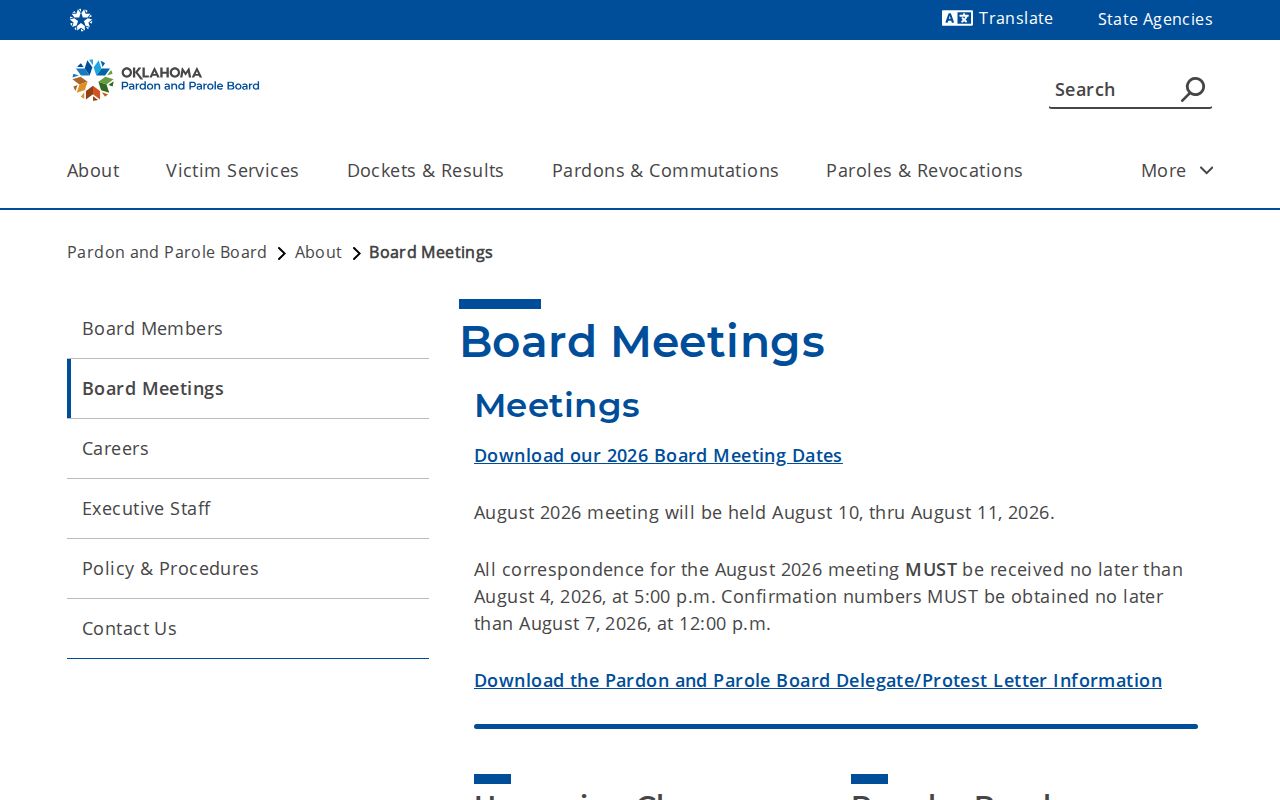
Use the live calendar for timing, then pair a posted result with ODOC status rather than treating the meeting date as a release date.
McIntosh Parole Decision Language
Oklahoma's result language changes with the offense category. The Board can grant parole in a nonviolent case. In a violent case, it can recommend parole to the Governor. That distinction means a posted favorable result may be a procedural milestone rather than final release authority. The Board can also pass a matter to a later docket or deny parole. None of the four outcomes supplies the physical release timestamp.
Eligibility is governed chiefly by 57 O.S. §332.7, with Board consideration rules in §§332.7 and 332.8. The enumerated-offense restriction in 21 O.S. §13.1 applies only when the conviction fits its current list. Board summaries generally describe nonviolent cases at one-third and violent cases after the required statutory portion, but exclusions and sentence facts prevent that summary from serving as a personal calculator. Death and life-without-parole sentences are outside ordinary parole consideration.
After a grant or recommendation, check whether all required conditions and release planning were completed. Then read the ODOC status and obtain the release record. A hearing result, even one posted after the meeting, does not prove when a McIntosh County person entered the community.
McIntosh County Supervision Office
McIntosh County has a notable office-routing issue. The live ODOC supervision table identifies McIntosh among inactive counties and does not give it a dedicated active office row. An older ODOC attachment listed an Eufaula office, but the current table is the stronger source. A person should not travel to that old listing or assume the sheriff's address is a parole reporting location. Ask ODOC or the assigned officer which active office owns the case.
Probation and Parole Services
Current county and office directory
McIntosh is shown among inactive counties; confirm the assigned active office.
The current directory image is available from ODOC Probation and Parole Services.
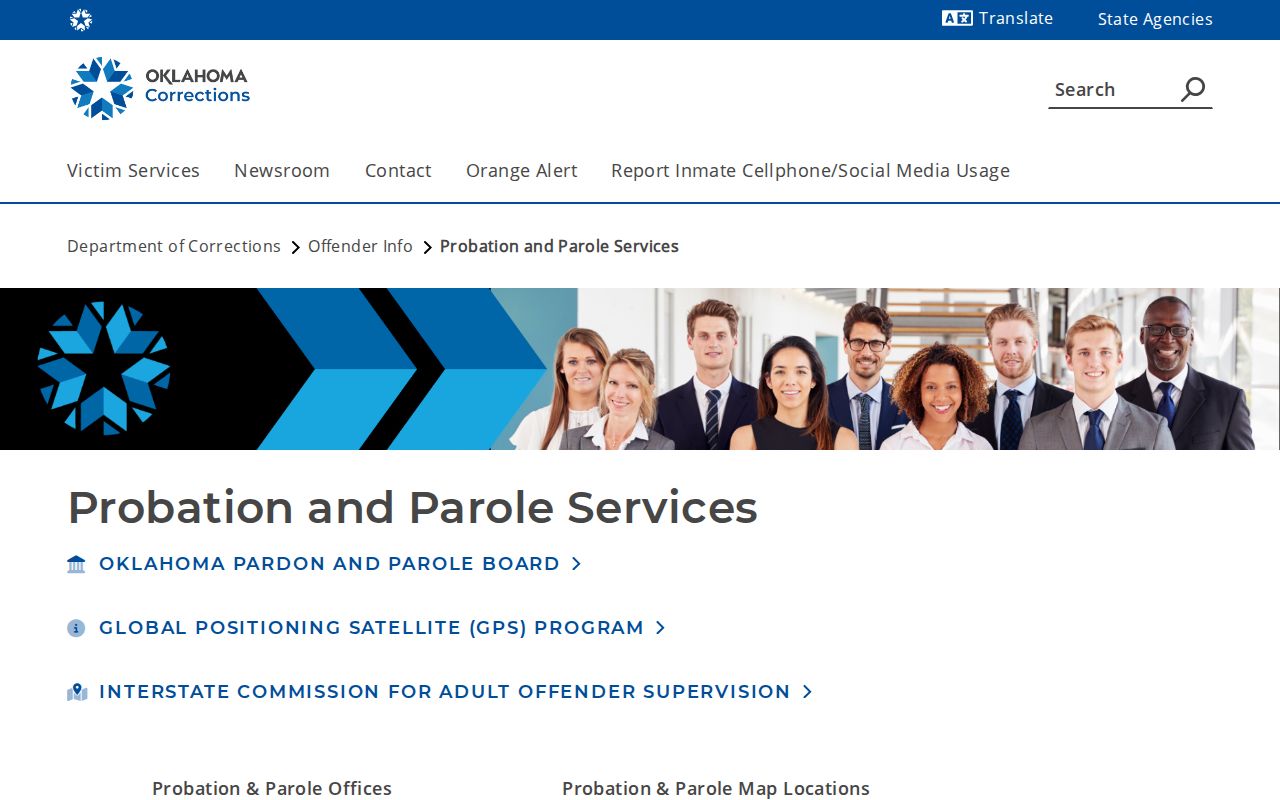
The directory's inactive-county label makes case-specific confirmation essential before any office visit or report attempt.
Note: The McIntosh County Sheriff's Office is the jail operator, not the agency that assigns an ODOC supervision office.
McIntosh County Supervision Conditions
Conditions are the rules attached to community supervision. The exact terms come from the parole certificate, court order, and supervising agency, not from a general county list. They may govern reporting, travel, treatment, contact, residence, payments, or conduct, but only the person's documents establish the binding terms. A parole condition arises within the continuing prison sentence. A probation condition rests on the court judgment and can be changed or enforced through the case.
An alleged violation does not by itself prove a new conviction. ODOC may investigate, alter supervision, or begin a revocation process. The court can address probation violations, while parole revocation follows the applicable correctional process. A new hold or warrant can lead to custody even though the earlier community release was real. Check the issuing system rather than reading a prior released status as proof the person remains free now.
McIntosh County Absconder Lookup
ODOC maintains a dedicated fugitives search. It is a statewide correctional route, not a McIntosh County warrant list. A fugitive or absconder indication means authorities allege that the person failed to remain available or comply with supervision. It does not show the person is physically in jail, and it does not establish a conviction for a new offense.
Confirm the identity and read the ODOC entry with the court docket. If the person appears in the fugitives view, ask ODOC which office or authority owns the status. A court warrant should be checked in the case that issued it. If current physical custody matters, contact the named custodian. The earlier release and a later absconder status can both be true because they describe different moments.
McIntosh County Supervision Discharge
Supervision ends through a recorded discharge, sentence expiration, or other lawful closing action. A statement that someone no longer reports is not enough. A case could have moved to another office, been tolled, become inactive for administrative reasons, or entered absconder status. Historical lookup data may also remain visible after the active term ends.
For formal proof, use ODOC Offender Records and Registries. Its records route lists Closed Records at 405-425-2691, osor@doc.ok.gov for inquiries, and osordischarges@doc.ok.gov for discharge questions. Supply the ODOC number and ask for discharge verification or incarceration and supervision records. Authorization from the person may be needed for material unavailable to the general public.
When the starting question is whether a McIntosh County jail detainee was released or transferred before supervision began, use the complete county search and release-record path on the McIntosh County released inmates home page. The official sheriff directory supplies the jail contact. This sequence separates a county bond release from an ODOC transfer and later parole, preventing a jail departure from being mistaken for unconditional discharge.
Note: Discharge closes the obligation shown by that record, but it does not rule out a different case or jurisdiction.